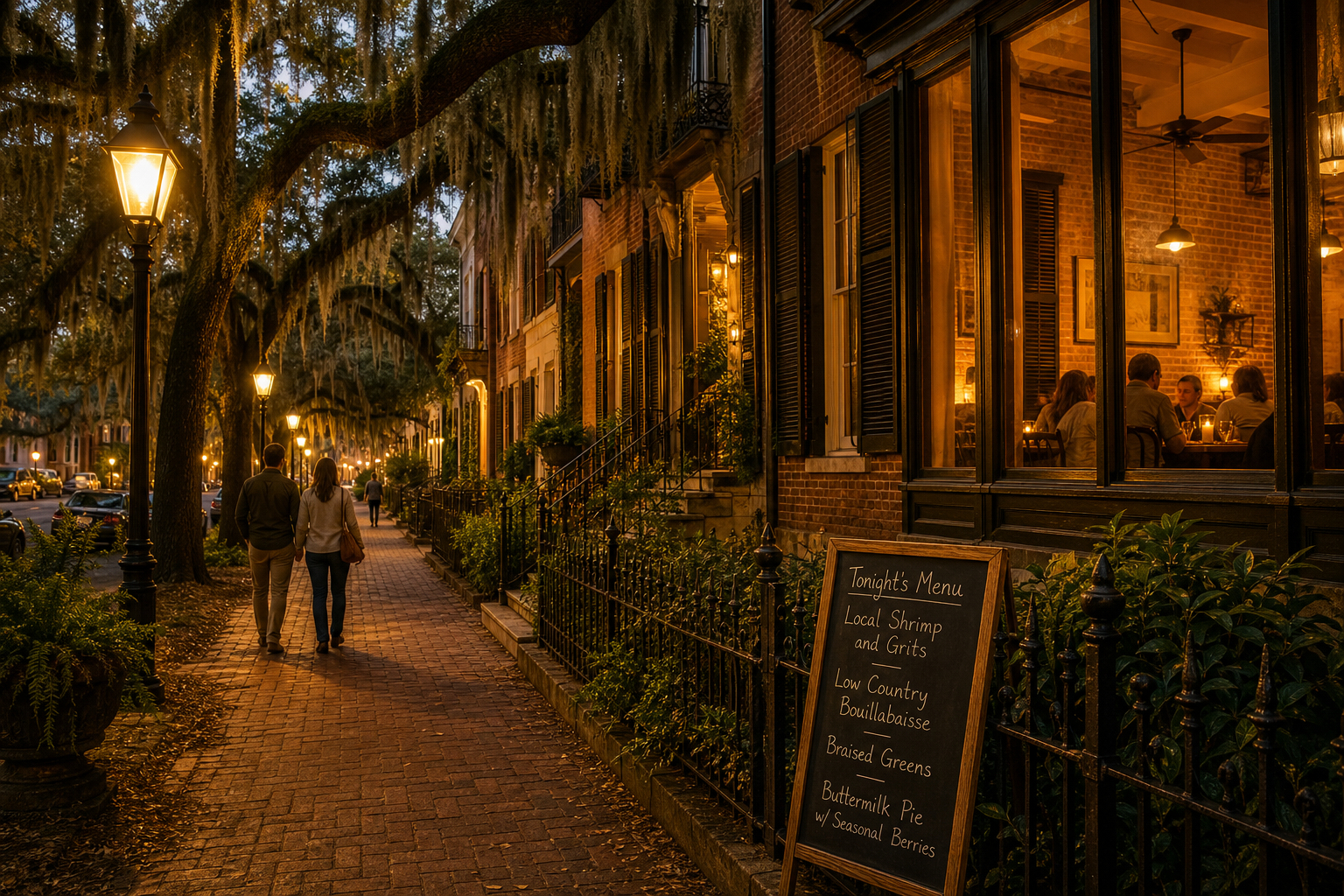
The restaurant with the biggest sign on River Street and the one a local swears by are rarely the same place.
Find your next meal in Savannah the local way
Explore Savannah's restaurant listings and find the spots worth the detour.
Why Savannah's food culture is unlike anywhere else in the South
Savannah sits at the intersection of the Atlantic coast and the Low Country, a geography that has shaped its food for generations. The city's culinary identity is built on two pillars: the deep Southern traditions of fried chicken, cornbread, collard greens, and mac and cheese, and the coastal abundance of wild Georgia shrimp, oysters, crab, and clams. Wild Georgia shrimp are notably sweeter and snappier than their Gulf counterparts, which is why shrimp and grits served over stone-ground, cheddar-enriched grits is the dish most worth using as a benchmark when sizing up any Savannah restaurant.
The setting matters too. Dining in a restored antebellum mansion or a converted 1938 Greyhound bus terminal is not a gimmick here; it is simply what the city looks like. That layering of history and ingredient-driven cooking is what makes Savannah's dining scene genuinely distinctive rather than just Southern-with-a-tourist-gloss.
The neighborhood breakdown every visitor needs to know
River Street is the most visible dining corridor in the city and also the most uneven. The waterfront setting is genuinely beautiful, but many of the restaurants here are calibrated for high foot traffic rather than repeat local customers. It is worth a walk and a drink, but residents rarely choose it for a serious meal.
Forsyth Park and the Victorian District offer a middle ground: a mix of well-regarded independent restaurants within easy walking distance of the park's landmark fountain, with a slightly more residential feel than the tourist core.
The Starland District and Ardsley Park are where the most interesting local dining is happening right now. Starland is Savannah's creative, gallery-lined neighborhood, and its restaurants reflect that energy. Ardsley Park, the city's first real suburb, clusters its best options along Waters Avenue and Bee Road. These are the streets where friends gather after work and families linger over weekend brunch, which is a reliable sign that the food is actually good. For a useful comparison of how other cities organize their dining by neighborhood, the West Loop restaurant guide shows a similar corridor-by-corridor logic at work.
The dishes that reveal whether a restaurant is the real thing
Certain dishes function as a kind of quality signal in Savannah. Shrimp and grits is the most reliable test: a kitchen that sources wild Georgia shrimp and uses stone-ground grits is paying attention to ingredients in a way that carries over to everything else on the menu. Pimento cheese, often served as an appetizer or a spread, is another marker; the house-made versions bear almost no resemblance to the jarred product.
Low Country Boil is worth seeking out in its communal format: shrimp, smoked sausage, corn, and red potatoes boiled in spiced seasoning and dumped directly onto a paper-covered table. It is a social meal as much as a culinary one, and the restaurants that serve it properly tend to understand what Savannah dining is actually about.
For a longer frame of reference on how regional ingredients define a city's restaurant identity, the Santa Barbara local restaurant guide covers a similar coastal-ingredient dynamic on the West Coast.
Savannah's landmark restaurants and what they actually represent
A few Savannah institutions have earned their reputations honestly. Mrs. Wilkes Dining Room has been serving lunch since 1943, cash-only, communal tables, no menu choices: platters of fried chicken, meatloaf, candied yams, and collard greens are passed around family-style among strangers. The line outside is real, but so is the food. Clary's Café carries a different kind of fame, largely from its appearance in *Midnight in the Garden of Good and Evil*, and remains a genuine neighborhood diner rather than a set piece.
The Grey, inside a restored 1938 Greyhound bus terminal, represents Savannah's more contemporary ambition: Chef Mashama Bailey won the James Beard Award for Outstanding Chef in 2022, making it one of the most decorated restaurants in the American South. These three establishments span the full range of what Savannah does well, from no-frills communal dining to nationally recognized fine dining, and each one is worth understanding before you decide where to spend your meals.
Four types of Savannah diners and where to point them
A couple on a romantic long weekend
For a couple looking for atmosphere alongside the food, Savannah's historic district delivers in a way few American cities can match. The combination of candlelit dining rooms inside restored 19th-century buildings and the city's famously unhurried pace makes it well-suited to long, leisurely dinners. Prioritize independently owned restaurants in the Victorian District or near Forsyth Park, where the setting feels genuinely local rather than staged for visitors. Booking a reservation at The Grey for one evening and balancing it with a more casual neighborhood spot on another night gives the trip a natural range.
A family wanting casual but genuinely good food
Families often do best by steering away from the most formal spots and toward the communal, relaxed formats Savannah does naturally. Mrs. Wilkes Dining Room is an ideal fit: the family-style service, the mix of strangers at shared tables, and the straightforward Southern food make it accessible for all ages, and the experience itself becomes a talking point. The Ardsley Park corridor along Waters Avenue and Bee Road also rewards a short drive from downtown with lower crowds and restaurants that feel like real neighborhood spots rather than tourist operations.
A solo traveler or food-focused visitor doing a tasting crawl
Savannah rewards the kind of visitor who wants to eat their way through a city methodically. A well-structured day might move from a morning biscuit and coffee in Starland, through a lunch of shrimp and grits at a Low Country-focused spot, to an afternoon pimento cheese tasting at a bar, and into an evening at a more ambitious kitchen. The Starland District is the right base for this kind of crawl: the neighborhood's density of independent restaurants and its walkability make it possible to cover serious culinary ground without a car. Finding out what's on in the evenings can also help a solo visitor time their meals around local events rather than tourist schedules.
Someone relocating who wants to understand the local food scene
A new resident's instinct is often to start with the famous names and work outward, but the smarter move is to begin in the neighborhoods where locals actually eat regularly: Ardsley Park, Starland, and the Midtown corridors. These areas have the restaurants that survive on repeat business rather than one-time tourist visits, which is a reliable proxy for consistent quality. Spending a few weekends working through brunch spots on Bee Road and dinner options in Starland builds a genuine mental map of the city's food culture faster than any single guide can. Guides covering other cities' local dining scenes, like the Sioux Falls local restaurant guide, can also offer a useful framework for how to approach a new city's food geography.
Savannah restaurant guide: questions locals get asked most
Find the Savannah restaurants locals actually return to
Savannah's best meals are in the neighborhoods, not on the marquees. Browse the Local Eyes Savannah restaurant listings to find the independently owned spots worth building your trip around.