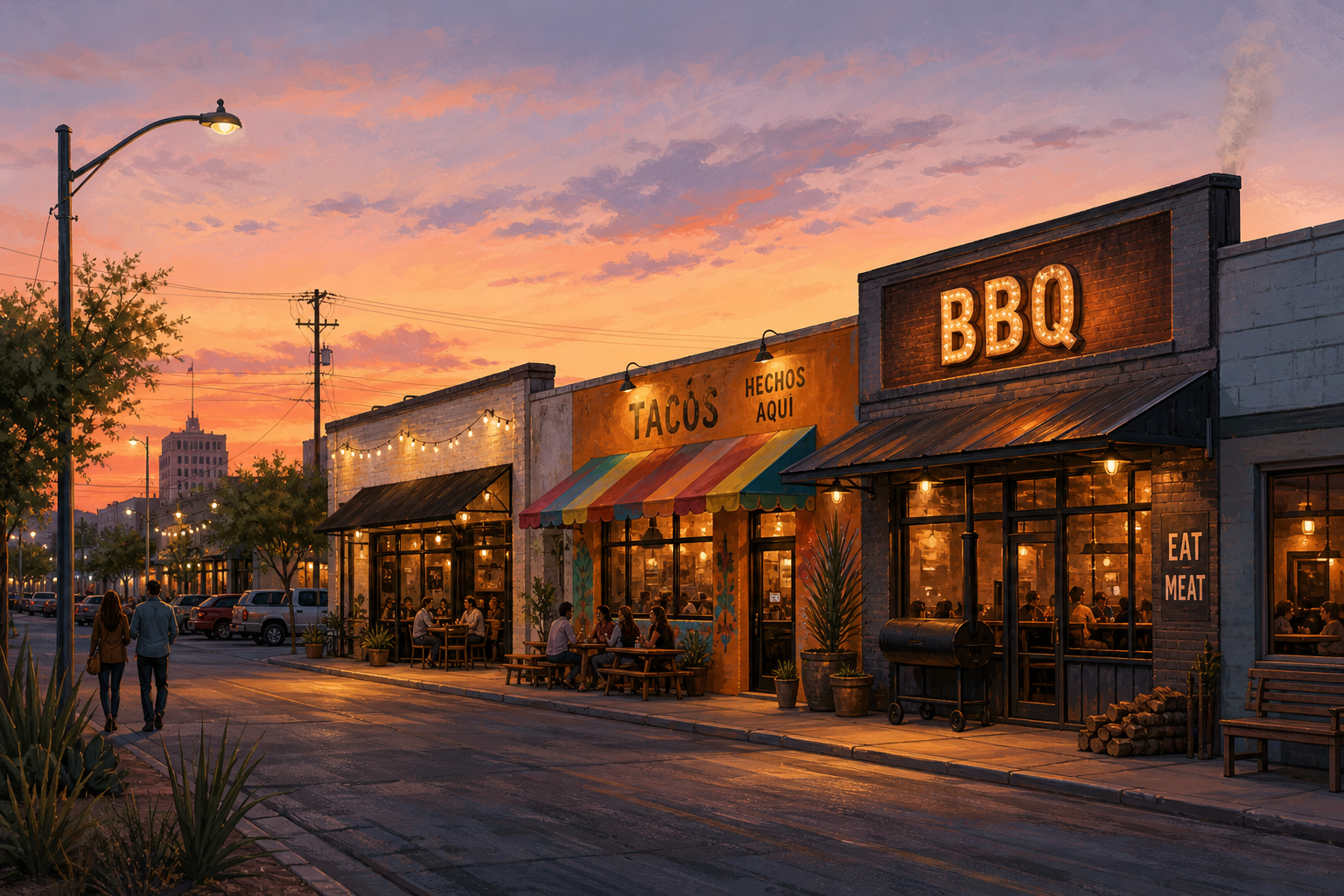
The taquerias and lunch counters that define Lubbock's everyday food culture rarely appear in national guides, but they are exactly where residents eat.
Find the restaurants Lubbock locals return to
Explore Lubbock's best local restaurants and find your next favorite neighborhood spot on Local Eyes.
West Texas shaped this city's food culture
Lubbock's dining scene is rooted in the landscape and communities around it. Tex-Mex and barbecue are not trends here; they are the baseline, and the city's agricultural heritage runs through nearly every menu. Talented chefs in the Hub City often take international cuisines and fold in a Texas perspective, so even a dish that looks familiar elsewhere tends to arrive with a regional inflection. That agricultural connection shows up in places like Claraboya Scratch Kitchen, which serves farm-to-table cuisine in a refined setting, and Cocina De La Sirena, which sources locally and changes its menu seasonally. If you want to understand where Lubbock eats, start with those two pillars: the deep-rooted traditions and the newer kitchens that are building on them. For a comparable read on another city's local dining logic, the West Loop restaurant guide offers a useful parallel.
Barbecue in Lubbock is a serious local institution
Barbecue occupies a near-sacred place in West Texas food culture, and Lubbock has two establishments that illustrate why. Evie Mae's Pit Barbecue opened as a food trailer in 2015 and has since become a perennial presence on Texas Monthly's list of top barbecue joints in the state. Brisket sells out regularly, which means arriving early is not optional. Tom & Bingo's Hickory Pit Bar-B-Que has been a family-owned institution since 1979, drawing a loyal hometown following that has little to do with outside recognition. These are not tourist destinations. They are places locals eat on Saturdays, bring out-of-town family to, and measure other barbecue against. The Shack BBQ is another spot worth knowing in the same conversation.
Tex-Mex runs deeper than the restaurant menus suggest
The Tex-Mex tradition in Lubbock is a genuine blend of Texan and Mexican culinary heritage, built from local ingredients and refined over generations. Abuelo's Mexican Restaurant has earned the Best of the West Award for Best Mexican Restaurant for ten consecutive years, which gives some indication of how seriously the city takes this category. But the more instructive places to look are the family-owned taquerias in neighborhood strip malls that rarely appear in national guides. These lunch counters and small dining rooms define the everyday food culture of the city far more than any award-winning establishment. Finding them takes a little local knowledge, which is exactly the kind of thing a community platform like Local Eyes is built to surface. For a sense of how this plays out in another city, see how Sioux Falls locals navigate their own restaurant scene.
The Depot District is where independent restaurants cluster
Along Buddy Holly Avenue, the Depot District functions as Lubbock's most concentrated stretch of independent dining. La Diosa Cellars is a Spanish bistro known for its tapas bar, extensive wine list, sangria, and live music in an art-filled setting. It is the kind of place that rewards lingering. The same stretch is home to Cast Iron Grill, Italian Garden, and Triple J Chophouse & Brew, each with a distinct identity. The Depot District is worth an evening rather than a single meal: the concentration of venues means you can move between spots, and the live music culture in the area adds a layer that pure restaurant districts rarely have. If that combination of food and live music appeals, the live music guide for Milwaukee shows how another city maps the same intersection.
Near Texas Tech, the food culture is its own ecosystem
The university area has its own dining logic, shaped by students, faculty, and the long-running neighborhood businesses that have survived multiple generations of Texas Tech classes. One Guy from Italy has become a student staple for giant slices and calzones, the kind of place that fills a specific need late in the evening and has built loyalty through consistency rather than ambition. Chimy's sits just steps from campus and draws a crowd that is reliably local. The West Table brings a different register to the area, featuring High Plains wines on its menu and leaning into the wine culture that is quietly growing across the region. For readers interested in that wine dimension, the local winery guide is a natural companion.
How to navigate Lubbock's restaurant scene like a local
- 1
Start with the category, not the name
Lubbock's food culture organizes itself around a few strong traditions: barbecue, Tex-Mex, Southern comfort food, and a growing farm-to-table strand. Before searching for a specific restaurant, decide which of these fits your mood. The category shapes the neighborhood you should be looking in, and often the time of day matters too. Barbecue spots like Evie Mae's sell out, so a lunch visit beats a dinner plan.
- 2
Map the neighborhoods before you go
The Depot District along Buddy Holly Avenue is the clearest cluster of independent restaurants, but the Texas Tech area has its own ecosystem and the strip malls scattered across the city hide some of the best family-owned spots. Knowing which part of Lubbock you are starting from helps you avoid driving past the places locals actually use. Local Eyes organizes listings by neighborhood, which makes this step faster.
- 3
Look past the national guides
National food publications cover Lubbock selectively, and their coverage skews toward destination restaurants rather than everyday local favorites. The taquerias, lunch counters, and neighborhood diners that define the city's real food culture rarely appear in those lists. Community platforms, local food writers, and word of mouth from residents are more reliable for this layer of the scene.
- 4
Check hours and sell-out patterns
Several of Lubbock's most popular spots operate on limited hours or run out of key items before closing. Brisket at Evie Mae's and The Shack BBQ sells out regularly, so an early arrival is the practical move. Calling ahead or checking a restaurant's current hours before visiting saves the frustration of arriving at a closed or sold-out kitchen.
- 5
Use seasonal and local menus as a signal
Restaurants that change their menus seasonally, like Cocina De La Sirena, are often the ones most connected to local agriculture and the most likely to reflect what is genuinely fresh in the region. A seasonal menu is a reliable indicator that a kitchen is sourcing thoughtfully rather than running a static operation. These spots tend to reward repeat visits more than fixed-menu restaurants.
Benefits
Barbecue with genuine state-level recognition
Evie Mae's Pit Barbecue has earned repeated placement on Texas Monthly's list of top barbecue joints, making it one of the few Lubbock restaurants with verifiable statewide recognition rather than just local reputation.
Tex-Mex rooted in local ingredients
Lubbock's Tex-Mex tradition draws on the region's agricultural heritage, with locally sourced ingredients and a culinary lineage that blends Texan and Mexican cooking in ways specific to West Texas.
A compact district for independent dining
The Depot District along Buddy Holly Avenue puts multiple independent restaurants within easy walking distance, making it possible to explore several venues in a single evening without committing to a single spot.
Farm-to-table tied to real local agriculture
Restaurants like Cocina De La Sirena and Claraboya Scratch Kitchen source locally and change menus seasonally, connecting diners directly to West Texas agricultural cycles rather than generic farm-to-table marketing.
A university area with its own food culture
The Texas Tech neighborhood supports a distinct dining ecosystem, from long-running student staples to High Plains wine-focused dining at The West Table, giving the area range beyond typical campus food.
Real situations this guide helps with
A new Texas Tech student finding local spots
A student arriving in Lubbock for the first time will quickly encounter the campus-area staples: One Guy from Italy for late-night slices, Chimy's for a reliably local crowd. But the real discovery comes from moving beyond that immediate radius. The Depot District is a short drive and offers a completely different register of dining, from tapas at La Diosa Cellars to the chophouse and brew options at Triple J. Building a mental map of the city's food neighborhoods early makes the four years ahead considerably more interesting.
A visitor who wants to eat like a resident
Travelers who want to skip the tourist-facing spots and eat where locals actually go should orient around two things: the barbecue institutions (Evie Mae's, Tom & Bingo's) and the family-owned Tex-Mex spots that do not advertise heavily. Abuelo's ten consecutive Best Mexican Restaurant awards give it credibility, but the strip-mall taquerias are where the everyday food culture lives. A single afternoon in the Depot District followed by a barbecue lunch the next morning covers the essential Lubbock experience efficiently.
A long-time resident looking for something new
Someone who knows the barbecue and Tex-Mex landscape well but wants to expand their range should look at the farm-to-table end of the scene. Claraboya Scratch Kitchen and The West Table represent a different approach to local ingredients, and The West Table's focus on High Plains wines connects Lubbock's dining scene to the wider wine culture of the region. The local winery guide is a useful next step for anyone following that thread.
Planning a group dinner in the Depot District
The Depot District is well suited to group dining because the concentration of venues means the group can agree on a neighborhood rather than a single restaurant. La Diosa Cellars works particularly well for groups who want tapas-style sharing alongside wine and live music. Cast Iron Grill and Triple J Chophouse & Brew offer more traditional sit-down formats for groups that prefer a single-venue evening. Booking ahead is advisable for any of these on a weekend.
Lubbock restaurant guide: questions locals actually ask
Discover where Lubbock locals eat, one neighborhood at a time
Lubbock has a food scene that rewards local knowledge, and Local Eyes is built to surface exactly that: the neighborhood spots, the long-running institutions, and the newer kitchens that residents actually return to. Browse the Lubbock restaurant listings on Local Eyes to find your next meal, or add your own restaurant to the platform so the locals who are already looking can find you.