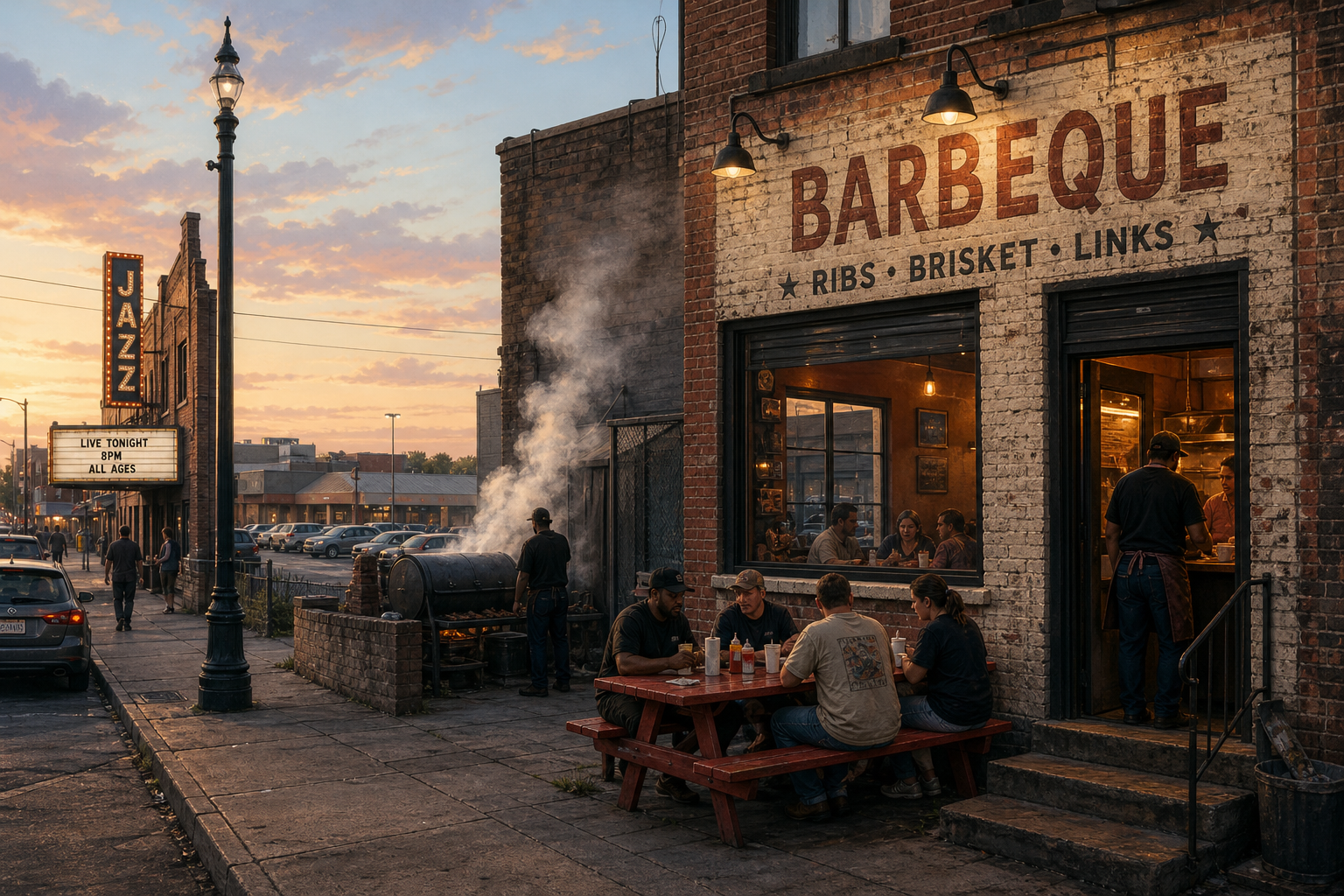
The best meal you will eat in Kansas City is probably behind an unmarked door in a strip mall, and the locals already have a table.
Find your next great KC meal, neighborhood by neighborhood
Explore Kansas City's dining scene the way residents do, starting with the neighborhoods that define it.
Neighborhood first, cuisine second: how KC dining actually works
Kansas City does not have one dining district. It has six or seven distinct ones, each with its own personality, price point, and regulars. Understanding which neighborhood suits your mood matters more than picking a cuisine category, because the same type of food, say a casual American dinner, feels completely different in Westport than it does on the Country Club Plaza or in Brookside.
Locals tend to anchor their dining habits to their own part of the city and branch out deliberately. A resident of the Crossroads Arts District might eat chef-driven food three nights a week and cross the river for a specific taqueria on a fourth. The geography of KC dining is not incidental; it is the guide. Visitors who skip the neighborhood logic and head straight for whatever tops a generic list often miss the meals that make the city worth talking about. Start with where you are or where you want to spend time, then find the food that belongs there.
A barbecue primer every visitor needs before the first bite
Kansas City barbecue is not one thing. The city's style is defined by a wide variety of meats, including beef and pork, which sets it apart from Texas (beef-dominant) and Memphis (pork ribs, often dry). The dry rub here typically balances sweet, savory, and a touch of heat, and the sauce, contrary to what many expect, is a thinner, tomato-based sauce with a sweet-and-tangy profile rather than the thick molasses-heavy bottled version many people associate with the city.
The distinction between sauce-forward and dry-rub-forward spots is real and worth paying attention to. Some pitmasters let the rub do the work and apply sauce only at the end or not at all. Others build the flavor in layers, applying sauce during the cook. Neither approach is more authentic; they reflect different lineages within the same tradition. Ask at the counter which style a restaurant leans toward. Anyone who knows their craft will have a clear answer.
18th and Vine: where Kansas City barbecue was born
The history of Kansas City barbecue runs directly through the 18th and Vine neighborhood. Henry Perry is credited as the originator of the style, and two of the oldest KC barbecue restaurants still operating trace their roots back to his pit. The district became the cradle of what the world now calls Kansas City barbecue, housing Perry's first restaurant location and the original site of what would become Gates Bar-B-Q.
Beyond barbecue, 18th and Vine earned the name "Jazz District" during the 1920s and 1940s, when it became the center of a new sound built on riffs. Jazz greats including Count Basie, Ella Fitzgerald, and Louis Armstrong all performed here, and the barbecue spots that fed musicians and crowds after jam sessions became institutions in their own right. Eating in this neighborhood is not nostalgia tourism; it is a direct line to the city's cultural foundation. For context on how live music and food have historically shared the same rooms in cities like this, the Kansas City live music scene offers a useful parallel.
The Crossroads, the Plaza, and the neighborhoods locals actually favor
The Crossroads Arts District, located just south of downtown, has become the most concentrated cluster of serious restaurants in the city over the last decade. Chef-driven restaurants, gallery dining rooms, and innovative casual spots have filled its blocks, making it the place to go for food that reflects where Kansas City's culinary ambitions are pointed right now.
The Country Club Plaza offers the most concentrated fine dining in the city, set against Spanish-influenced architecture and aimed squarely at Kansas City's professional dining crowd. It is polished and reliable, but locals who want something less curated tend to drift toward Westport, one of the city's oldest commercial districts, where Pennsylvania Avenue and Westport Road pack an unusually wide range of cuisines into a walkable stretch. For everyday neighborhood eating, Southwest Boulevard and the Westside form KC's Mexican food corridor: family-run taquerias, panaderías, and carnicerías that have almost nothing to do with tourist dining and everything to do with feeding a community. Similar neighborhood-first dining logic shapes guides like the West Loop restaurant guide, where geography determines character just as strongly.
Practical habits that separate a good KC meal from a forgettable one
The most celebrated Kansas City meals frequently happen in strip malls and unassuming storefronts. A willingness to eat somewhere that looks like nothing from the outside is the single most useful instinct a visitor can develop. Locals know this instinctively; the exterior signals nothing about what is happening at the grill or in the kitchen.
A few practical notes. The Kansas City metropolitan area has more than 100 barbecue restaurants, so the question is never whether to get barbecue but which style and which neighborhood. Lines at the best spots are real and worth planning around; arriving early or at off-peak hours makes a meaningful difference. For date-night dining, the Crossroads and the Plaza offer the widest range of reservation-friendly, chef-driven options. For everyday meals, Brookside and Westport reward walking and wandering. And if you are new to the city and building a mental map of where to eat regularly, the Sioux Falls restaurant guide shows how the same neighborhood-first logic applies across Midwestern cities with similarly underrated dining scenes.
Four ways to eat in Kansas City like you live there
First-time visitor planning a barbecue crawl
A visitor with two days and a specific mission: eat the barbecue Kansas City is actually known for, not the version that shows up in airport gift shops. The right approach is to anchor one meal in 18th and Vine, where the style originated, and a second in the Crossroads or on the east side, where newer pitmasters are working within the same tradition. Sampling both a dry-rub-forward spot and a sauce-forward one in the same trip makes the difference between the two styles immediately legible. Order burnt ends at least once; they are a Kansas City invention and not widely replicated elsewhere with the same result.
A couple looking for a date night beyond the obvious
The Country Club Plaza is the default answer for a special-occasion dinner, and it delivers reliably. But locals looking for something more distinctive tend to book at chef-driven spots in the Crossroads, where the dining rooms are smaller, the menus change more frequently, and the cooking reflects a more personal point of view. Reservations at Crossroads restaurants fill faster than most visitors expect, so planning a week ahead rather than the night before is the practical move. Westport also has a handful of spots that work well for a relaxed dinner before catching live music nearby.
A family relocating and building everyday eating habits
Newcomers to Kansas City often spend the first few months eating at the same handful of well-reviewed spots before realizing the city rewards neighborhood loyalty. Brookside and Waldo are where many KC families build their regular rotation: approachable restaurants, owner-operated spots, and the kind of places where the staff starts to recognize you. Southwest Boulevard is essential for anyone who wants good Mexican food at non-tourist prices. Getting to know one or two spots in your own neighborhood before branching out is how most long-term residents actually eat, and it produces a more satisfying relationship with the city's food scene than chasing lists.
A solo traveler navigating KC without a car
Kansas City is a car-centric city, and the honest answer is that some of the best eating requires wheels or a rideshare. That said, Westport and the Crossroads are both walkable dining destinations with enough density to spend a full evening without moving a car. The Plaza is similarly walkable within its own footprint. For a carless visitor, concentrating one or two days in each of these neighborhoods and using rideshare for the specific barbecue spots worth the trip, like those in 18th and Vine, is the most practical strategy. Local guides organized by neighborhood, like those on Local Eyes, make it easier to plan a day around a specific area rather than a scattered list of addresses.
Kansas City restaurant guide: questions locals get asked
Kansas City's dining scene rewards locals and curious visitors equally
Local Eyes maps Kansas City's restaurants, events, and neighborhood guides in one place, organized the way residents actually think about the city. Browse by neighborhood, find what's happening this week, and build a picture of KC that goes beyond the usual top-ten lists.